Since the ChatGPT moment in November of 2022, US equity markets have charged higher on the back of the artificial intelligence (AI) trade. In the early stages of the rally, returns were driven largely by the hyperscalers and semiconductor companies. As capital expenditures (capex) at the hyperscalers and frontier labs pushed up into the hundreds of billions of dollars,1 technology hardware and power generation names linked to the buildout of the physical infrastructure needed to support surging demand rose strongly.
An investment cycle felt across the economy
The infrastructure buildout linked to AI has had impacts far beyond financial markets. Estimates vary, but one analysis from the Federal Reserve Bank of St. Louis found that AI-related investment accounted for roughly 39% of US GDP growth in the first three quarters of 2025.2 Across industries exposed to the buildout, backlogs have swelled to record levels, and in some instances, deliveries of key components are booked years in advance.
Simply put, the current investment cycle is proving to be truly transformational, both in financial markets and the real economy.
The questions that remain
Throughout the buildout, important questions have persisted and as the rally in markets has extended, concerns have grown. How durable is the spending by the hyperscalers and frontier labs in the face of growing debt loads and weakening cash flow? When will companies start to see returns on the massive outlays, and will those returns justify the spending? Will public backlash act as a governor on data center construction? What will AI adoption ultimately look like, and where will the economic gains accrue? The answers to these questions will shape the coming quarters and years in financial markets and the real economy.
Early answers are arriving
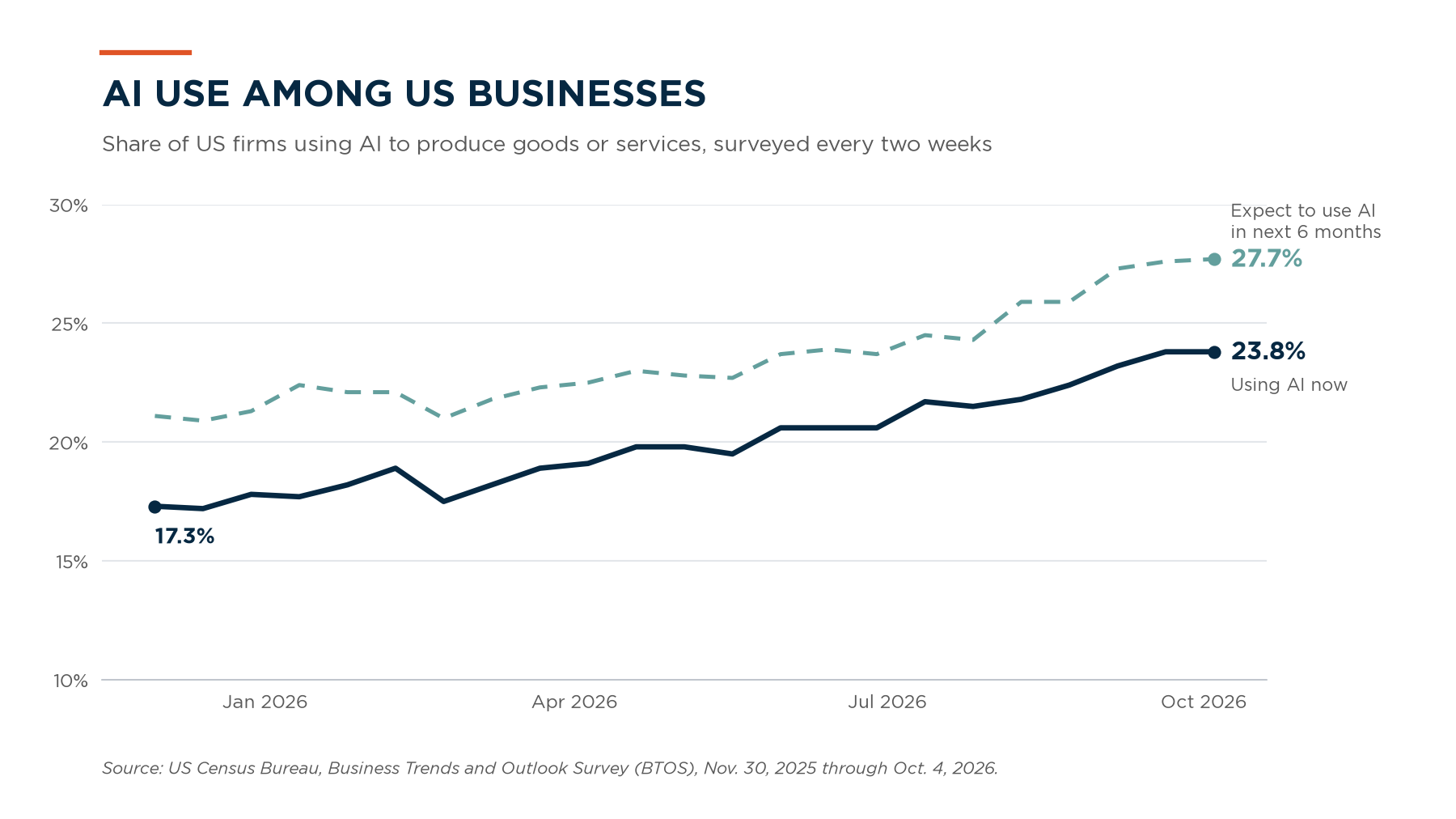
While these uncertainties exist, we are also starting to get important answers. Cloud growth at the hyperscalers has accelerated on the back of rising AI demand. Cybersecurity companies are reporting record numbers and openly discussing how AI threats are transforming the industry. Legacy software companies, only recently viewed as structural losers, are seeing strengthening top-line growth as the adoption of AI-powered tools increases. Industries such as banking and pharmaceuticals are using AI to increase efficiency and reduce costs, while AI agents are increasingly being deployed to assist consumers and businesses alike in everyday tasks. Across the corporate landscape, the evidence that AI is creating real economic value is becoming harder to ignore.3
From buildout to adoption
As with any technological revolution throughout history, AI will create winners and losers, and change is never comfortable. We are closer than ever to getting answers to how competing forces will ultimately be resolved. While realizing the path will not be smooth, the emerging evidence of adoption and economic value creation leads us to be optimistic about AI’s long-term potential. We believe that the most important impacts of the AI revolution still lie ahead; they will be revealed as we transition from an infrastructure buildout to a prolonged period of AI adoption. These shifting dynamics are sure to be reflected in financial markets, and we believe that our process will help us to uncover long-term winners for our clients.
Key terms
- ChatGPT moment: The public release of OpenAI’s ChatGPT chatbot in November 2022, widely seen as the point when AI tools reached a mass audience.
- The AI trade: The rise in stock prices of companies that investors expect to benefit from the growth of artificial intelligence.
- Rally: A sustained rise in stock prices.
- Hyperscalers: The largest cloud computing companies. They run vast networks of data centers and rent computing power and storage to other businesses.
- Cloud computing: Renting computing power, data storage, and software over the internet instead of buying and running the equipment yourself.
- Semiconductors: Computer chips. Training and running AI requires large numbers of specialized, high-performance chips.
- Frontier labs: Companies that build the most advanced AI models, sometimes called “frontier” models.
- Capital expenditures (capex): Money a company spends on long-lived physical assets such as buildings, equipment, and data centers.
- Data center: A facility that houses thousands of computer servers, along with the power and cooling systems needed to run them.
- Gross domestic product (GDP): The total value of goods and services produced in a country. GDP growth is the most common measure of how fast an economy is expanding.
- Backlog: Orders a company has received but not yet filled. A growing backlog signals that demand is running ahead of supply.
- Cash flow: The cash a business brings in minus the cash it spends to operate and invest. Weaker cash flow can make it harder to keep spending without borrowing.
- Legacy software companies: Established software makers whose products predate the current wave of AI, and which some investors feared AI tools would replace.
- Top-line growth: Growth in a company’s revenue, or sales, which sits on the top line of its income statement.
- AI agents: AI programs that can carry out multi-step tasks on a person’s behalf, such as answering a customer service request or scheduling a meeting.
Sources
1 Based on CooksonPeirce analysis of company filings, as of the second quarter of 2026. Covers capital expenditures by the largest cloud computing companies (hyperscalers) and frontier AI labs.
2 Hannah Rubinton and Bontu Ankit Patro, “Tracking AI’s Contribution to GDP Growth,” Federal Reserve Bank of St. Louis, On the Economy, January 12, 2026. The estimate covers investment in information processing equipment, software, research and development, and data centers.
3 Based on CooksonPeirce analysis of company filings, as of the second quarter of 2026. Covers recent results and commentary from cloud computing, cybersecurity, software, banking, and pharmaceutical companies.
Chart: US Census Bureau, Business Trends and Outlook Survey (BTOS), biweekly survey periods from November 30, 2025 through October 4, 2026.
Important Disclosures
Investing involves risk, including possible loss of principal. Investment decisions are subject to market, currency, economic, and business risks and will not always be profitable. There is no guarantee that risk can be successfully mitigated or otherwise avoided.
Past performance is no guarantee of future results.
Nothing discussed in this material should be considered an offer to buy or suggestion to sell securities.
Statements using “if,” “may,” “can,” “should,” “will” or similar may be forward looking and are not intended as an opinion, projection, or estimate regarding the market, CooksonPeirce, or its products.
Cookson Peirce & Co., Inc. is an SEC registered investment adviser. Registration does not imply a certain level of skill or training. See Form ADV at adviserinfo.sec.gov.
The views expressed are those of the CooksonPeirce Investment Management team as of October 2026 and are subject to change without notice. References to industries or types of companies are for illustration only and are not recommendations to buy or sell any security.
Risk Disclosures
Market Risk. The price of a security, bond, or mutual fund may drop in reaction to tangible and intangible events and conditions. This type of risk is caused by external factors independent of a security’s particular underlying circumstances. For example, political, economic, and social conditions may trigger market events.
Business Risk. These risks are associated with a particular industry or a particular company within an industry. For example, oil production companies depend on the lengthy process of finding, extracting, transporting, and then selling oil before they can generate a profit. As a result, an oil production company carries a higher risk of profitability than an electric utility company, which generates its income from a steady stream of customers who buy electricity no matter what the economic environment.
Equity (Stock) Risks. Common stocks are subject to general stock market fluctuations and to volatile increases and decreases in value as market confidence and perception of their issuers change. There is also a certain level of company or industry specific risk that is inherent in each investment. There is the risk that the company will perform poorly or have its value reduced based on factors specific to the company or its industry.
Technology Sector Risk. Companies in the technology sector, including those tied to artificial intelligence, can be especially volatile. They may be affected by rapid changes in technology, intense competition, product obsolescence, government regulation, and high valuations.
About CooksonPeirce
CooksonPeirce is a Pittsburgh-based, 100% employee-owned registered investment adviser founded in 1984, with more than $3 billion in assets under management.